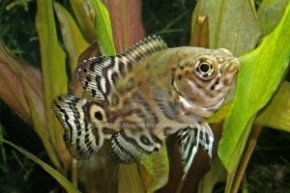
SCIENTIFIC NAME: CRENICICHLA PROTEUS FLORIDA BRED The Compressiceps Pike Cichlid, also referred to as the Banded Pike Cichlid, is native to the rapids of the lower Tocantins River (a branch of the Amazon River) in Eastern Brazil. Compressiceps Pike Cichlids are rather bold and not afraid to be out in the open, which makes for enjoyable, close observation of their natural behavior. Although small at just over three inches, Compressiceps Pike Cichlids need a lot of swimming space and territory, requiring an aquarium of at least 55 gallons. They should be provided with a fine sand substrate as well as driftwood and rocks for territory and hiding places. Live plants are preferred as they increase biological filtration and most pike species take advantage of the cover while hunting for live food. Compressiceps Pike Cichlids prefer soft, acidic water in pristine condition with a moderate rate of flow as well as quality biological and mechanical filtration. Lighting intensity should be on the low to moderate side with enough intensity for surface plants as well as a few low-light and Micro-sword species. Compressiceps Pike Cichlids can be very aggressive for their size and should only be kept with other aggressive species; if they are housed with their own kind, only one male is recommended unless a larger aquarium is provided (one to three females would be fine with one male). Tank mates should be considered carefully and should be similar or slightly larger in size; pike species will eat most live food that will fit in their mouths. While most pike species (especially wild-collected) are strictly piscivorous (fish eaters), Compressiceps Pike Cichlids are carnivorous insectivores and prey on insects as their main food source in the wild. In the aquarium, they will feed on live brine shrimp, ghost shrimp, daphnia, small minnows, tadpoles, small crickets, and various types of small worms, but can usually be trained to accept frozen or fresh, prepared meaty foods such as chopped krill, vitamin-enriched brine shrimp, chopped earthworms, and chopped pieces of fish; some specimens may eventually be trained to accept freeze-dried or other prepared food items, but it's not always the case.