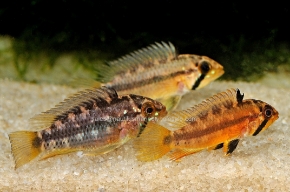
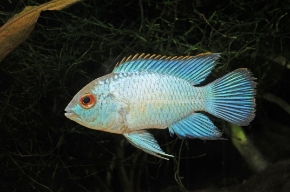
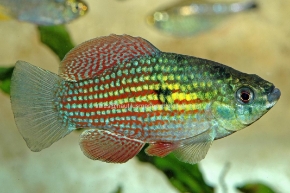
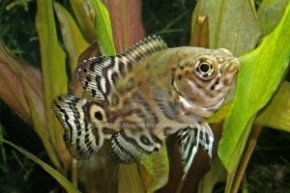
SCIENTIFIC NAME: HAPLOCHROMIS SP., Kyoga Flameback, is for the most part, a peaceful aquarium resident as far as cichlids go and will stand out in any aquarium they inhabit (including the albino variety). Males will become aggressive among each other with the onset of spawning, but in general remains rather placid. Despite its maximum size of 6 inches (comparatively speaking), the Kyoga Flameback can be easily bullied by other species so care and observation is crucial when choosing tank mates. To successfully maintain Kyoga Flameback, one should house a colony in a tank of no less than 40 gallons, preferably larger. A sand or small grain gravel substrate is favored as this cichlid enjoys ‘scooping’ at the bottom while sifting for food. This vertical head plunging is a constant leisure activity. The Kyoga Flameback, when content with its environment, prefers open areas. As with all responsible aquatic husbandries, adequate filtration and frequent water changes are required to keep this fish, as well as all others, in prime condition. Feeding should consist of a high quality flake containing both protein and vegetable matter although a diet of spirulina flake with frozen or live brine shrimp, daphnia, or the like, is also suitable. At 6 cm (a little over 2 inches), males will begin to display the red coloration for which they are known. This usually occurs at seven months of age or so. Male coloration indicates sexual maturity, so the first attempt at spawning takes place soon thereafter. The act of spawning is typical of the haplochromines from the region. The male’s color intensifies while claiming and defending a small territory. This region is concentrated around some object (usually a rock). The male will dart at the ripe female and dance tilted to one side, displaying his fully extended fins. She will eventually enter his territory and the two will begin circling each other. The male tilts so that his anal fin is laying on the substrate. The ocelli resemble the female's eggs in both color and size. As she nips at the egg spots, the male releases milt. She drops a small number of eggs and quickly turns to pick them up into her mouth. This process continues until she has fully expelled. She then leaves the spawning area to find a quiet area in which to brood her clutch. After 18 days (gestation period is dependent on water temperature) the larvae have fully absorbed their egg sac and the female releases her fry for a short spurt, to forage. Over the next two weeks the female releases her brood more often scooping them back into her buccal cavity when she feels they are in danger. The young will eventually be left to fend for themselves. Brood sizes are large and can number in excess of 50. To ensure survival, it’s recommended to raise the fry in a separate tank where they grow quickly on a diet of finely crushed flake and Cyclop-eeze®.